
Do have a sailing story, news, or helpful sailing-related information to share?
Please contact P/C Steve Harris to have it included. We’d love to hear from you.
Each week this season, we will offer a “quiz” question regarding the Racing Rules of Sailing. Read the scenario below, formulate your answer, then move your mouse over the box to reveal the correct answer. Need further explanation? Each week this season, we will offer a “quiz” question regarding the Racing Rules of Sailing. Read the scenario below, formulate your answer, then move your mouse over the box to reveal the correct answer. Need further explanation? Thirty seconds before the starting signal, Boat W is nearly wayless, her sails flapping. About one length prior to becoming overlapped to leeward, Boat L hails, “Leeward boat!” W takes no evasive action. One second after L becomes overlapped to leeward of W, L has to bear away to avoid contact with W. W begins trimming her sails and heading up immediately after the overlap is established. L protests. The protest committee finds that W, having been given adequate warning of the impending situation, fails to keep clear of a leeward boat, thereby breaking rule 11, On the Same Tack, Overlapped. W appeals. You are on the appeals committee; how would you decide this? Boat W’s appeal is sustained; neither boat is penalized. Adequate time for response is incorporated into rule 15, Acquiring Right of Way, by its requirement to initially allow a newly obligated boat “room to keep clear.” This rule does not require a boat clear ahead to anticipate her requirement to keep clear as a wind- ward boat before the boat clear astern becomes overlapped to leeward. When L becomes overlapped and therefore the right-of-way boat, rule 15 requires her to give W “room to keep clear,” which she does by immediately bearing away and giving W space to maneuver away from her. Though W is momentarily breaking rule 11, On the Same Tack, Overlapped, when L has to change course to avoid contact, W is trimming her sails and heading up; therefore she is sailing within the room she is entitled to, and is exonerated (freed from penalty) for breaking rule 11 by rule 43.1(b), Exoneration. Thereafter she keeps clear, fulfilling her obligation under rule 11. (See US Sailing Appeal 119 and World Sailing Case 53.) Each week this season, we will offer a “quiz” question regarding the Racing Rules of Sailing. Read the scenario below, formulate your answer, then move your mouse over the box to reveal the correct answer. Need further explanation? Red is sailing upwind toward Green, who is sailing downwind. As they approach each other, Red calls for right of way. Green does not respond, so Red changes course to avoid Green. Green should take a penalty. Both boats are on the same tack (port). Neither boat is clear ahead, so the boats are overlapped. Therefore, Rule 11 applies. Green is the windward boat and must keep clear of Red. This quiz was borrowed from the Inland Lake Yachting Association‘s #FairSailing initiative Each week this season, we will offer a “quiz” question regarding the Racing Rules of Sailing. Read the scenario below, formulate your answer, then move your mouse over the box to reveal the correct answer. Need further explanation? True or False? You can be penalized if you do not avoid contact with another boat, even if you have the right of way. TRUE – Rule 14 states, “A boat shall avoid contact with another boat if reasonably possible.” This quiz was borrowed from the Inland Lake Yachting Association‘s #FairSailing initiative Each week this season, we will offer a “quiz” question regarding the Racing Rules of Sailing. Read the scenario below, formulate your answer, then move your mouse over the box to reveal the correct answer. Need further explanation? Boat Q, a doublehanded trapeze boat, wins the race. On shore, Q is listed as OCS on the score sheet. Q makes a scoring request to the race committee and is told that, though her hull was not over the starting line, her crew’s head and shoulders were on the course side of the starting line when she went out on the trapeze seconds before the starting signal. Q requests redress. Boat Q is entitled to redress under rules 62.1(a), Redress, and 64.3, Decisions on Redress. She should be scored in her finishing place. The definition Start says that a boat starts: “…when, her hull having been entirely on the pre-start side of the starting line at or after her starting signal… any part of her hull crosses the starting line from the pre-start side to the course side.” Q’s hull is entirely on the pre-start side of the starting line at the starting signal and therefore she starts correctly. It is immaterial where her crew’s body is at the starting signal.Racing Rules Weekly Quiz
something we can discuss on the porch on Sunday.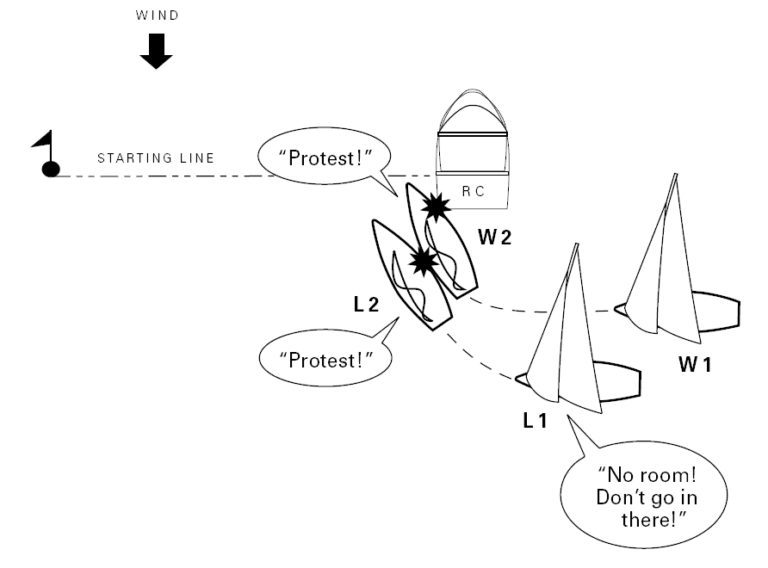
This Week’s Question
Two 25-foot boats, L (a leeward boat) and W (a windward boat), are approaching the right-hand end of the starting line, a 30-foot powerboat, to start an upwind leg. Both boats are beam reaching, with L on a course to pass one length to leeward of the race committee boat. Twenty seconds before the starting signal and when two lengths from the race committee boat, L hails, “No room! Don’t go in there!” to W. Both boats hold their courses until W is overlapped to leeward of the race committee boat. At that point L luffs and W makes con- tact nearly simultaneously with both L and the committee boat. There is dam- age to the starboard side of L but not serious damage. Both boats protest each other. You are on the protest committee; how would you decide this?
Answer
Boat L is penalized under rules 14, Avoiding Contact, and 16.1, Changing Course. The preamble to Part 2, Section C, At Marks and Obstructions, states that rules 18, Mark-Room, 19, Room to Pass an Obstruction and 20, Room to Tack at an Obstruction, do not apply “at a starting mark surrounded by navigable water or at its anchor line from the time the boats are approaching them to start…”. Therefore the situation is governed by the rules in Sections A and B. At the time W becomes overlapped to leeward of the race committee boat, she is keeping clear of L in compliance with rule 11, On the Same Tack, Overlapped (Section A rule). Rule 16.1 requires L, as a right-of-way boat, to give W room to keep clear of her when she changes her course (Section B rule). When L luffs, there is not room (space) for W to comply with the Part 2 rules and rule 31, Touching a Mark, due to the physical presence of the race committee boat (see the definition Room). Therefore L breaks rule 16.1. W breaks rules 11 and 31 but is exonerated (freed from penalty) by rule 43.1(b), Exoneration.
L also breaks rule 14 for failing to avoid a collision, and is penalized under that rule because the contact results in damage to herself. However, from the time L begins to luff, it is not possible for W to avoid contact; therefore W does not break rule 14.
Had L wanted to prevent W from passing between her and the committee boat, she should have luffed sooner while W was still able to respond to her luff without making contact with the committee boat (see World Sailing Cases 114 and 146).
This quiz was excerpted from Dave Perry’s 100 Best Racing Rules Quizzes available from US Sailing. For a comprehensive explanation of the rules, read Dave Perry’s Understanding the Racing Rules of Sailing through 2024, which is also available from US Sailing. Permission to reprint this quiz for non commercial use is granted by the author. Racing Rule Weekly Quiz
something we can discuss on the porch on Sunday.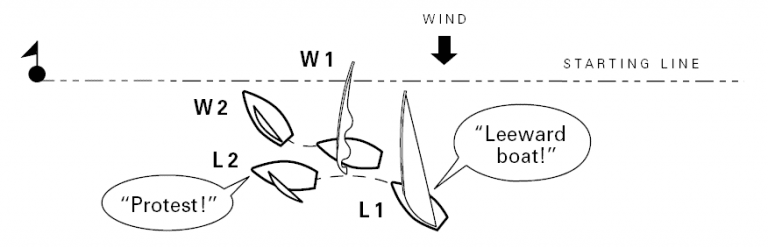
This Week’s Question
Answer
This quiz was excerpted from Dave Perry’s 100 Best Racing Rules Quizzes available from US Sailing. For a comprehensive explanation of the rules, read Dave Perry’s Understanding the Racing Rules of Sailing through 2024, which is also available from US Sailing. Permission to reprint this quiz for non commercial use is granted by the author.Racing Rules Weekly Quiz
something we can discuss on the porch on Sunday.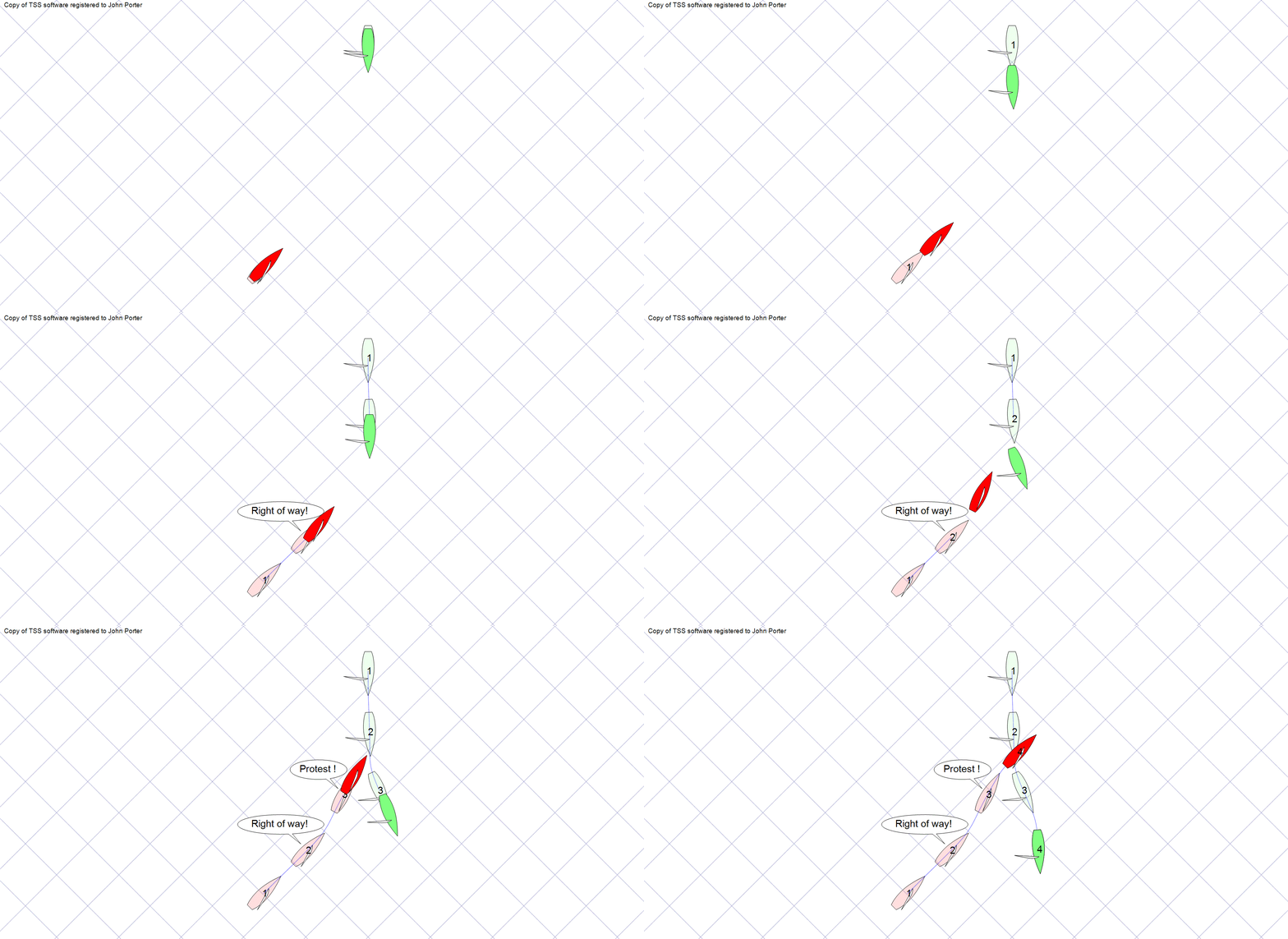
This Week’s Question
Which boat(s) should promptly take a penalty?
Answer
Learn more at sailzing.comRacing Rules Weekly Quiz
something we can discuss on the porch on Sunday.
This Week’s Question
Answer
As a right-of-way boat, you can be penalized under this rule if you did not take action to avoid contact and the contact causes damage or injury.
Learn more at sailzing.comRacing Rules Weekly Quiz
something we can discuss on the porch on Sunday.
This Week’s Question
You are on the protest committee: how do you decide this?
Answer
This quiz was excerpted from Dave Perry’s 100 Best Racing Rules Quizzes available from US Sailing. For a comprehensive explanation of the rules, read Dave Perry’s Understanding the Racing Rules of Sailing through 2024, which is also available from US Sailing. Permission to reprint this quiz for non commercial use is granted by the author.